Discover how a conversational chatbot can transform your customer service, offering speed and efficiency while improving the user experience.
What is a conversational chatbot? Conversational chatbots are computer programs designed to interact with users through natural, human-language conversations. They use advanced technologies such as natural language processing (NLP) and artificial intelligence (AI) to understand and respond to user queries. Unlike traditional rule-based chatbots, conversational chatbots can learn and adapt over time, providing more accurate and relevant responses.
Conversational chatbots can be integrated into various communication channels, such as websites, mobile applications, instant messaging platforms, and social networks. This allows businesses to provide omnichannel customer service that is readily available
A modern conversational chatbot no longer simply processes data; it analyzes the intention and emotion behind every word. Thanks to sentiment analysis, AI can detect a customer's frustration or satisfaction and adapt its tone in real time. This emotional dimension humanizes the digital relationship and strengthens user trust in your brand.
24 hours a day, 7 days a week. By automating repetitive tasks and providing instant answers, conversational chatbots can significantly improve customer service efficiency.
Furthermore, conversational chatbots are capable of handling high volumes of queries simultaneously, making them particularly useful for businesses with a large customer base. Through machine learning, these chatbots can also analyze conversation data to identify trends and recurring issues, thus facilitating strategic decision-making.
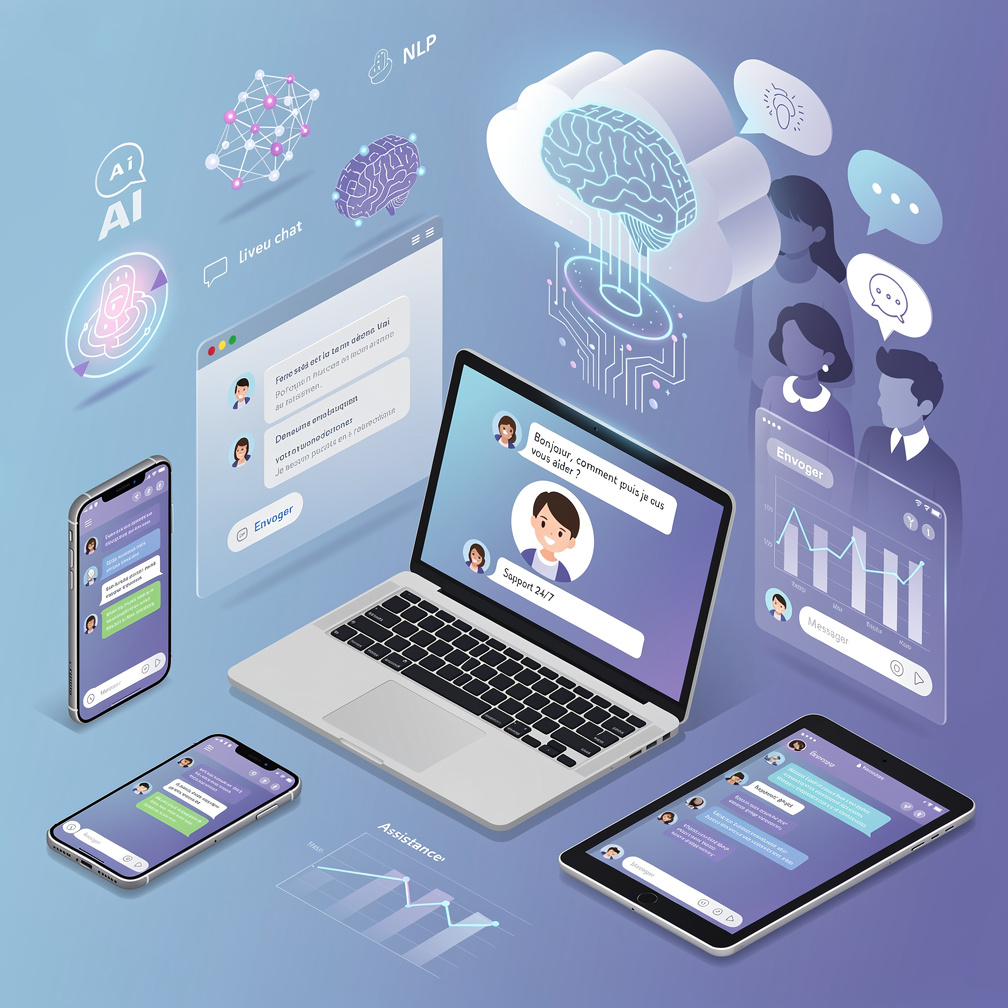
The advantages of a chatbot for customer service
One of the main advantages of a chatbot for customer service is its continuous availability. Unlike human agents, who need breaks and rest periods, chatbots can operate without interruption. This means customers can get help at any time, even outside of business hours, which significantly improves their satisfaction.
Furthermore, conversational chatbots reduce customer wait times. By providing instant answers to common questions, chatbots can free up human agents from repetitive tasks, allowing them to focus on more complex issues. This leads to faster problem resolution and better utilization of human resources.
Finally, chatbots can collect and analyze real-time data, providing valuable insights into customer behavior and preferences. This information can be used to personalize future interactions, improve products and services, and develop more effective marketing strategies. In short, a well-integrated chatbot can transform customer service into a powerful tool for building loyalty and driving growth.
How a chatbot improves the customer experience
A conversational chatbot can greatly improve the customer experience by providing fast and accurate assistance. Customers appreciate being able to get immediate answers to their questions without having to navigate complex menus or wait on hold to speak to an agent. This responsiveness contributes to a smoother and more enjoyable user experience.
Furthermore, chatbots can personalize interactions based on customers' historical data. For example, a chatbot can greet a customer by name, remind them of previous purchases, or suggest products and services based on their past preferences. This personalization strengthens the customer's sense of connection and perceived value, which can increase loyalty and satisfaction.
Conversational chatbots are also capable of handling multilingual interactions, which is particularly beneficial for businesses operating internationally. By offering support in multiple languages, chatbots can reach a wider audience and provide high-quality assistance, regardless of the customer's location or language. This reinforces the perception of an inclusive and accessible company.
Types of chatbots: rules vs. AI
There are two main types of chatbots: rule-based chatbots and AI-powered chatbots. Rule-based chatbots follow a predefined set of scripts and responses. They are programmed to answer specific questions using predetermined keywords or phrases. While simple to develop, these chatbots are limited in their ability to handle complex or unexpected conversations.
In contrast, AI-powered chatbots use natural language processing and machine learning algorithms to understand and answer user questions. They can learn and improve over time by analyzing past conversations and adjusting their responses accordingly. These chatbots are capable of handling more sophisticated interactions and providing more accurate and contextual answers.
The choice between a rule-based chatbot and an AI-powered chatbot depends on the specific needs of the business and the complexity of customer interactions. For simple, repetitive tasks, a rule-based chatbot may suffice. However, for more nuanced and personalized interactions, an AI-powered chatbot is often preferable. Ultimately, the goal is to choose a chatbot type that can deliver the best possible customer experience
How to choose the right chatbot for your business
Choosing the right chatbot for your business requires a careful assessment of your specific needs and objectives. First, it's important to define the types of tasks the chatbot will need to perform. Will it answer frequently asked questions, guide users through an ordering process, or provide technical support? Understanding the main use cases will help you determine the necessary features.
Next, consider integration with your existing systems. The chatbot may need to connect to your customer database, customer relationship management (CRM) system, or other business tools. Ensure that the chatbot you choose can easily integrate with these systems to guarantee a seamless and consistent user experience.
It's also crucial to consider the chatbot's scalability and flexibility. Is your business growing rapidly? Will you need to add new features or handle an increasing volume of requests? An AI-powered chatbot can offer greater flexibility and scalability compared to a rule-based one. Finally, don't overlook the importance of the assistance and technical support provided by the chatbot vendor.
Integrating a chatbot into your customer service
Integrating a chatbot into your customer service begins with careful planning. First, identify the touchpoints where the chatbot will be most helpful. This could include your website, mobile app, or even messaging platforms like Facebook Messenger or WhatsApp. Once you've identified these touchpoints, work with your technical team to ensure a seamless integration.
Next, training the chatbot is crucial. For a rule-based chatbot, this means programming scripts and responses for common questions. For an AI-powered chatbot, it involves training it with real-world data to improve its understanding and ability to answer queries. This training phase is essential to ensure the chatbot can provide accurate and helpful answers from the outset.
Finally, test the chatbot in real-world conditions before deploying it on a large scale. Involve team members and loyal customers to gather feedback and make adjustments. Also, be sure to continuously monitor the chatbot's performance after deployment, using analytics tools to identify areas for improvement and optimize the user experience.
Best practices for implementing a chatbot
Implementing a successful conversational chatbot relies on a set of best practices. First, define clear and measurable objectives for what you hope to achieve with the chatbot. This could include reducing customer wait times, improving customer satisfaction, or increasing sales. These objectives will help guide the development and optimization of the chatbot.
Another best practice is to start small and iterate. Rather than launching a chatbot with every possible feature, begin with simple use cases and add features over time. This allows you to test and gradually improve the chatbot, minimizing initial risks and costs.
It's also essential to continuously monitor and analyze chatbot performance. Use analytics tools to track key metrics such as query resolution rate, average response time, and customer satisfaction. This data will provide valuable insights for optimizing the chatbot and ensuring it continues to effectively meet customer needs.
Case studies: companies that have succeeded thanks to chatbots
Many companies have successfully transformed their customer service through the integration of conversational chatbots. For example, the airline KLM launched a chatbot on Facebook Messenger to assist customers with flight information, real-time updates, and answers to frequently asked questions. The chatbot enabled KLM to reduce wait times and improve customer satisfaction, while freeing up human agents for more complex tasks.
Another example is Sephora, the cosmetics chain, which uses a chatbot on its website and messaging platforms to offer personalized product recommendations, makeup tutorials, and answers to frequently asked questions. This chatbot has not only improved the online shopping experience but has also helped increase Sephora's online sales.
Finally, HSBC integrated a chatbot into its mobile app to provide instant assistance with questions related to accounts, transactions, and banking products. The chatbot helped HSBC offer faster and more efficient customer service while reducing operational costs. These examples demonstrate how chatbots can be a valuable asset for various industries.
Measure the effectiveness of your chatbot
To measure the effectiveness of your conversational chatbot, it's essential to track a set of key metrics. One of the most important metrics is the query resolution rate. This measures the proportion of customer requests that are resolved by the chatbot without human intervention. A high resolution rate indicates that the chatbot is efficient and capable of handling a wide variety of questions.
Another important metric is average response time. This measures how quickly the chatbot responds to user queries. Fast response times are essential for maintaining a positive user experience and reducing customer frustration. Additionally, it's helpful to track customer satisfaction, often measured through post-interaction surveys or Customer Satisfaction Scores (CSAT).
Finally, analyze the qualitative data from interactions with the chatbot. Examine the conversations to identify pain points, misunderstood questions, and opportunities for improvement. Use these insights to refine the chatbot's responses, improve its AI algorithm, and adjust the conversation scripts. By monitoring and analyzing these metrics regularly, you can continuously optimize your chatbot's effectiveness.
Conclusion and future prospects for chatbots in customer service
In conclusion, conversational chatbots represent a revolution in customer service. They offer significant advantages in terms of speed, efficiency, and availability, while improving the user experience through personalized and instant interactions. Businesses of all sizes and sectors can benefit from integrating chatbots into their customer service operations.
In the future, advancements in artificial intelligence and natural language processing technologies will continue to make chatbots even more sophisticated and capable. We can expect to see chatbots that understand and respond to even finer nuances of language, can handle more complex conversations, and offer unprecedented levels of personalization. Furthermore, the integration of chatbots with other emerging technologies, such as augmented reality and virtual reality, will unlock new possibilities for immersive and engaging customer experiences.
Ultimately, conversational chatbots are not just a passing trend, but an essential component of modern customer service strategy. Companies that adopt and optimize this technology now will be well-positioned to deliver exceptional customer service and stand out in an increasingly competitive market.